RFactorial builds AI infrastructure, voice AI, AI agent platforms, and project and portfolio management that help organizations create new capabilities and put them to work.
Each family covers a different layer of how an organization works — the infrastructure it runs on, its conversations, the AI agents that work for it, and the way it runs its projects and portfolio. Together they multiply the capacity of infrastructure, teams, business operations, and employees.
Summarize this week’s supplier updates and set follow-ups.
Done — summary drafted from approved files. Two follow-ups added to your tasks.
Tasks
Follow up: supplier AThu
Review summaryFri
Supplier callThu · 10:00
FilesMemoryMCP toolsCalendar
Personal and role-based agents inside an organization-controlled workspace.
IntakeVettingBuildDemoLive
Flows and forms you buildStages · gates · tools on every step
One dashboard for managementFollow-ups · status · the whole ecosystem
Projects and products move through the flows you build; management sees all of it.
Infrastructure
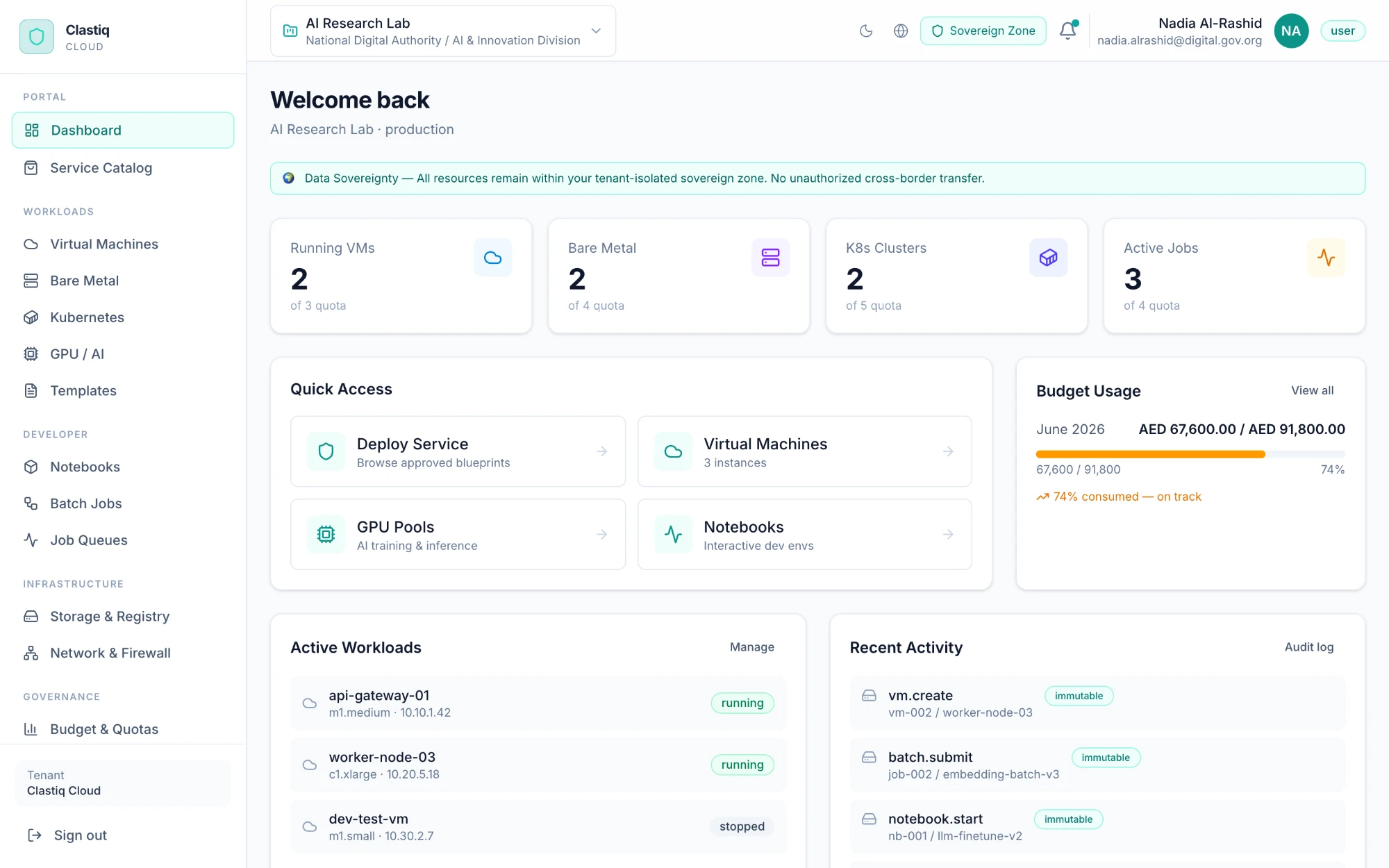
Clastiq
Private AI infrastructure, sovereign by design.
A private-cloud orchestration platform that lets cloud providers and large organizations operate and offer governed services across virtual machines, bare metal, GPU/AI clusters, storage, and networks — from their own infrastructure.
Built for cloud providers, telecoms, large enterprises, and regulated institutions.
Unified control planeCoordinate OpenStack, MAAS, Kubernetes, SLURM, Ceph, storage, and network.
Service catalogVMaaS, MaaS, CaaS/KaaS, GPU/AI, storage, and networking through approved blueprints.
Tenant & identityOrganizations, projects, SSO, RBAC, quotas, and resource boundaries.
Commercial operationsPricing, metering, budgets, chargeback, and invoice export.
Rovetta turns recorded conversations and uploaded audio into structured documents you can review, search, and download — meeting minutes, lecture notes, interview and work reports, or clinical notes — in one private workspace.
Built for teams and professionals, students and educators, researchers and interviewers, and clinics.
Record or uploadRecord in the browser or upload an existing file — up to three hours of audio.
Choose the reportMeeting, class, interview, work, or clinical: the report follows the format you pick.
Private file libraryEvery report is kept with its original audio, ready to play back.
Keyword and semantic searchFind the passage you need across all your files, without replaying recordings.
Download anywhereExport reports as PDF, HTML, or plain text.
Pay per minutePrepaid credit, charged only when a finished report is saved.
Privacy — audio, reports, and search results are encrypted and visible only to their owner. Clinical notes are drafts for professional review.
Live translation for two-person video meetings. Each participant chooses the language they want to hear, and Resonor translates speech in both directions during the call — with workspaces, invitations, and chat keeping the conversation in one place.
Built for international business teams, service providers with overseas clients, and professionals working across borders.
Two-way live translationTwo independent streams translate each person’s speech as the call goes on.
Your own languagesEach participant picks the language they speak and the language they hear.
Video stays onVideo continues while translated audio plays; listeners can lower or mute the original voice.
Workspaces and chatCreate a workspace, invite a colleague, and chat before and after the call.
Translation you switch onOff by default; either participant turns it on after the app explains how audio is processed.
Availability — in controlled pilots with recurring one-to-one meetings and selected language pairs.
AVA handles routine customer calls and moves spoken requests toward a useful outcome. It combines voice conversation, your business knowledge, and configured workflows, so common questions are answered, routine steps get done, and a person takes over when needed.
Built for small and medium-sized businesses and enterprise service teams with recurring phone inquiries — clinics, e-commerce, and other service providers.
Inbound and outbound callsCustomers speak with AVA by phone, in either direction.
Knowledge and FAQsAnswers about your services, business information, and uploaded knowledge.
AppointmentsAvailability checks, booking, rescheduling, and cancellation through a connected calendar.
Order inquiriesOrder status from a connected business system.
Human escalationHands the call to a person when the request needs more support.
Review and controlConfigure the agent around your process and review call logs, recordings, and activity.
Getting started — begin with one recurring workflow, validate call quality and hand-off, then expand.
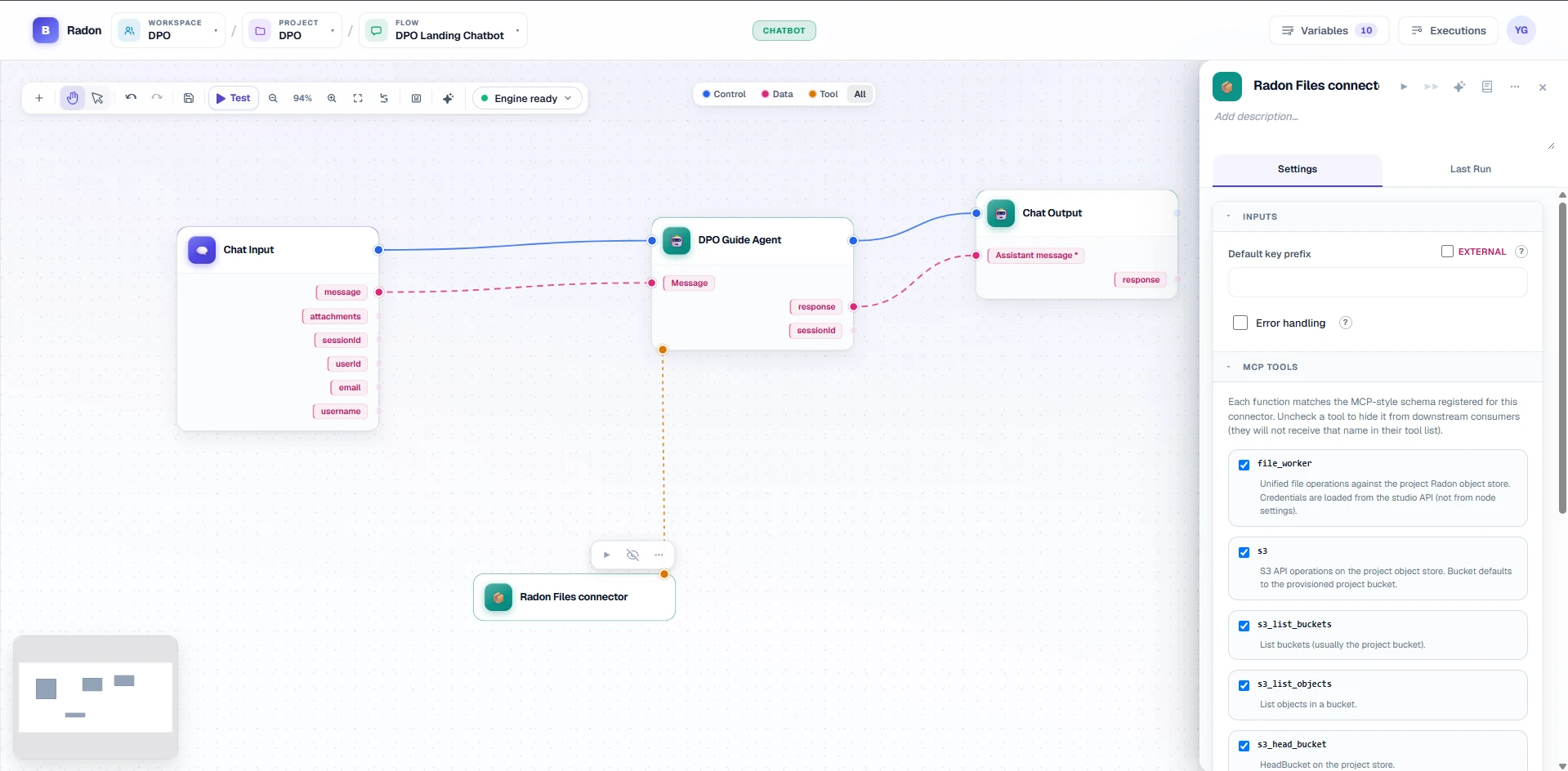
A visual low-code enterprise platform for building, orchestrating, deploying, and operating workflows, chatbots, and AI-agent services across organizational systems.
Built for large enterprises, public institutions, operations, product and IT teams, integration teams, and system integrators.
Visual low-code studioWorkflows, chatbots, agents, and service logic on a visual canvas.
Reliable orchestrationStateful, parallel workflows with node testing, execution history, and recovery.
Enterprise integration126+ ready-made modules for APIs, systems, data, models, messaging, MCP tools, and browser actions.
Agentic servicesAgents, sub-agents, tools, knowledge, prompts, and approvals.
Controlled deploymentDeploy each flow independently with Docker or Kubernetes in approved infrastructure.
Enterprise administrationOrganizational structure, Keycloak-based identity, environments, logs, and runtime control.
Deployment — self-hosted on Docker/Kubernetes with enterprise authentication, environment separation, and per-flow runtime control.
A dedicated enterprise AI-agent workspace that gives employees personal or role-based agents able to use approved memory, files, MCP tools, tasks, and calendars — while the organization keeps control of models, data, access, cost, and deployment.
Built for large enterprises, public institutions, regulated industries, and shared-service teams.
Personal agent workspaceRole-based agents with instructions, specialization, language, tone, provider, and scoped context.
Memory & filesUser-and-agent-scoped memory and approved files, without cross-context leakage.
Tasks & calendarTurn conversations into tasks, deadlines, follow-ups, and dashboards.
MCP toolsConnect agents to organizational tools with defined scopes and permissions.
Every project, product, and process in your ecosystem — in one place.
A project, portfolio, and operations platform for large ecosystems of companies and teams. Build your own processes with the flow and form builders, put the right tools on every step, and run projects, tasks, and the whole portfolio through them — with a dashboard that gives management the full picture.
Built for holdings and large ecosystems — their member companies, teams, and suppliers — and the managers who lead them.
Flow builderDesign any process as stages, statuses, gates, and rules — as many flows as you need.
Form builderIntake and project forms with 14 field types, shared by public link.
Tools on every stepPut the right tools on each step: forms, scoring, checklists, workstreams, deliveries, tickets.
Projects & tasksDefine projects, assign tasks with reviews and deadlines, and follow every item up.
Meeting minutes from speechRecord a meeting and get its minutes as text, right inside the product.
Portfolio managementEvery product and project in the ecosystem, tracked through the flows you built.
Management dashboardFollow-ups, product status, and the state of the whole ecosystem in one view.
Agents & integrationsAn MCP endpoint for AI agents, plus Jira, GitLab, email, and object storage.
Deployment — self-hosted with Docker, or as a multi-tenant SaaS, with isolated workspaces, role-based access, and a full audit trail.
Each product can be adopted on its own. The illustrations are conceptual — not product screenshots.
Infrastructure✦Voice AI✦AI agents✦Operations✦Infrastructure✦Voice AI
Clastiq✦Rovetta✦Resonor✦AVA✦Radon✦Radon Mini✦DPO✦Clastiq Lite✦Radon in the box✦Clastiq✦Rovetta
02Practical applications
What the products make possible.
Six illustrative scenarios across the product families, showing the kind of work each product is designed to support.
Scenario 01Clastiq
Turn infrastructure into cloud services
A cloud operator brings virtual machines, bare metal, GPU clusters, and storage under one multi-tenant control plane — then offers them to tenants through an approved, metered service catalog.
Scenario 02Rovetta
Turn recordings into searchable reports
A team records its weekly meeting and gets complete minutes with decisions and action items; a lecturer turns a recorded class into structured notes; a clinic drafts a visit note for the doctor to review — all searchable later, without replaying the audio.
Scenario 03Resonor
Meet across languages, one to one
Two partners who don’t share a language meet by video. Each speaks their own language and hears the other translated live into theirs — with chat in the same workspace before and after the call.
Scenario 04Radon
Connect an operational workflow
An operations team models a request-and-approval process on a visual canvas, connects it to existing systems through ready-made modules, and runs it as its own service inside approved infrastructure.
Scenario 05Radon Mini
Equip employees with approved AI agents
A department gives each employee a role-based agent that works with approved files, memory, tools, tasks, and calendars — while the organization keeps control of models, access, usage, and cost.
Scenario 06DPO
Run an ecosystem’s projects and products in one place
A holding builds its own processes with the flow and form builders. Its companies’ projects and products move through them with tasks, meetings, and minutes, while management follows every item — and the whole ecosystem — from one dashboard.
Scenarios are illustrative and describe intended use. They are not customer case studies.
03How we build
One repeatable path from need to product.
RFactorial turns recurring organizational capability gaps into reusable, scalable AI products. Every product we build adds components, integrations, and deployment patterns to a shared foundation — so the next one starts further ahead.
01of 07Discover
01
Discover
Identify high-cost, repeatable organizational problems worth solving as a product.
OutputProblemBuyerWorkflowBaselineBusiness case
02
Define
Translate the problem into a product, a buyer, a workflow, and a measurable outcome.
OutputRequirementsScopeRoadmapAcceptance criteria
03
Architect
Design infrastructure, data, agent, integration, security, and operating boundaries.
OutputInfrastructureData & integrationSecurityOperating model
04
Build
Develop the product using shared platform components and specialist teams.
OutputWorking incrementsReusable components
05
Validate
Pilot with a design partner and measure value, reliability, adoption, and risk.
OutputScenario demoPilotTelemetryUser feedback
06
Productize
Standardize deployment, pricing, documentation, support, and governance.
Every product adds reusable technology, integrations, governance controls, and deployment patterns to the shared foundation — lowering the effort and risk of building the next.
BuildA new product
ValidateEvidence from real use
ReuseShared components
ExpandNew capabilities and markets
CompoundLower effort for each next build
Shared foundation
BuildNew product
ValidateReal-use evidence
ReuseShared components
ExpandNew capabilities
CompoundLower next-build effort
04Company
A multidisciplinary team that builds end to end.
RFactorial is the product brand of Cognition Ai and Technology Innovation SPC, headquartered in Muscat, Sultanate of Oman. It combines software architecture, applied AI/ML, backend and platform engineering, cloud operations, DevOps, infrastructure security, product management, product design, and business development in one delivery organization — with fewer handoffs between idea, build, deployment, and adoption.
Tell us about the capability you want to create or the process you want to improve, and which product looks closest to your need. Not sure yet? Describe the problem — that's a good place to start.